
Evolution: Street Art and Graffiti in Baltimore
By Margaret Dalbey | May 24, 2026
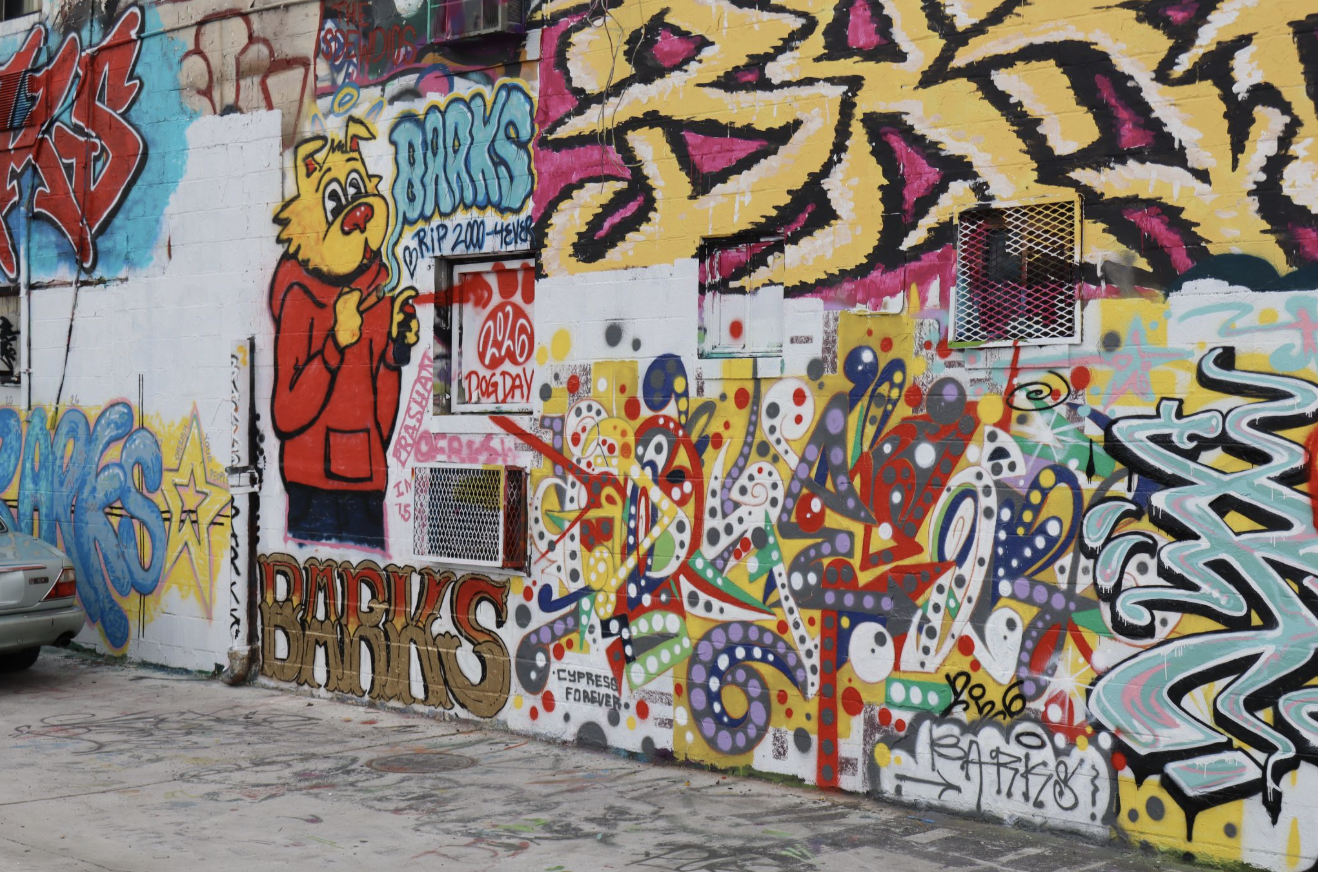
Photo of Graffiti Alley taken by Margaret
DEFINITIONS
Street art is commonly known as a public, sometimes unsanctioned, form of visual expression, including graffiti (which focuses on stylized lettering and symbols), murals, stencils, posters, installations, and more. Street art is hard to define because it is constantly evolving; there are no limits to what this artistic expression can look like.
Street art is unique because it exists only outside of private galleries and museums, in a way that can’t be avoided or sheltered. The audience is forced to face it in public rather than choosing to experience it.
Some argue street art necessarily has a political edge, a reflection or critique of society, a dictation or transcription of history. Some say nonpolitical street art is trivial and a crude attempt at “entertainment” when it can be used for so much more. But one must ask: What does it mean to be political?
These natural, unrestrained expressions of life are a source of cultural and community pride. Where did street art begin?
HISTORY
Street art and graffiti, along with hip-hop, gained popularity first in New York City in the 1970s and 1980s and spread as a subculture to other major cities. Street art in Baltimore has roots in MICA students along with many, many others. Some of the first graffiti artist tags in the city are known as BEAU (an older Black worker), REVOLT, CUBA, and DILLINGER, as artist Chris Stain describes in a Baltimore Magazine article (Cassie).
Contemporarily, many murals are sponsored by MICA and the Baltimore Office of Promotion & the Arts, or BOPA, essentially a nonprofit city arts council, according to "Street Art in Baltimore: A Catalyst for Change" (Stone and Buckley). Baltimore City has also launched a few projects over the years in an effort to discourage vandalism, such as the 2012 Open Walls Project, which Stain participated in, and the Folklife Apprenticeship, which funds a mentor artist and apprentice artist to work and create art together for one year.
There is also neighborhood-level support of art through the Creative Alliance in Highlandtown, Jubilee Arts in Sandtown-Winchester, and Arts Every Day in Bolton Hill. These organizations provide community spaces that allow for exposure to all forms of art (dance, music, visual arts, and ceramics) and uplift Baltimore as a center of artistic production.
Over time, street art has become more accepted by mainstream culture, while graffiti continues to resist bureaucracy, which is seen in the commissioning of large-scale murals like the I-83 graffiti cleanup project that The Baltimore Banner reported on just weeks ago.
WHY
Art is joy. Art is creativity. Art is memory. Art is power. Art is resistance. Artistic expression can be a means of survival in all types of environments. In particular, graffiti’s use is vast, and its impact is massive.
Graffiti is done by kids wanting to create something of their own. Graffiti is done as commentary on violence and politics, seen with the Freddie Gray murals (N. Mount St. and Presbury St.; Presbury St. and N. Fulton Ave.) in Sandtown after his murder and the following protests and vigils.
In this way, graffiti can capture social movements when understood in the context of its transient environment. Graffiti can be painful, while its beauty is simultaneously awful and inspiring.
Graffiti is an exercise of power, especially in Black communities that have been historically discriminated against in Baltimore through segregation and redlining, which has led to the "Black Butterfly" and "White L." Art is not only used to exercise power, but it is power.
HIGHLIGHTS / IN BALTIMORE
One unique opportunity for artists exists in the form of Graffiti Alley, a legal space between Howard Street and North Avenue to do street art without bounds. According to Atlas Obscura (Blank), this alley was designated by the Graffiti Warehouse (whose office is adjacent to the alley) and opened in 2005.
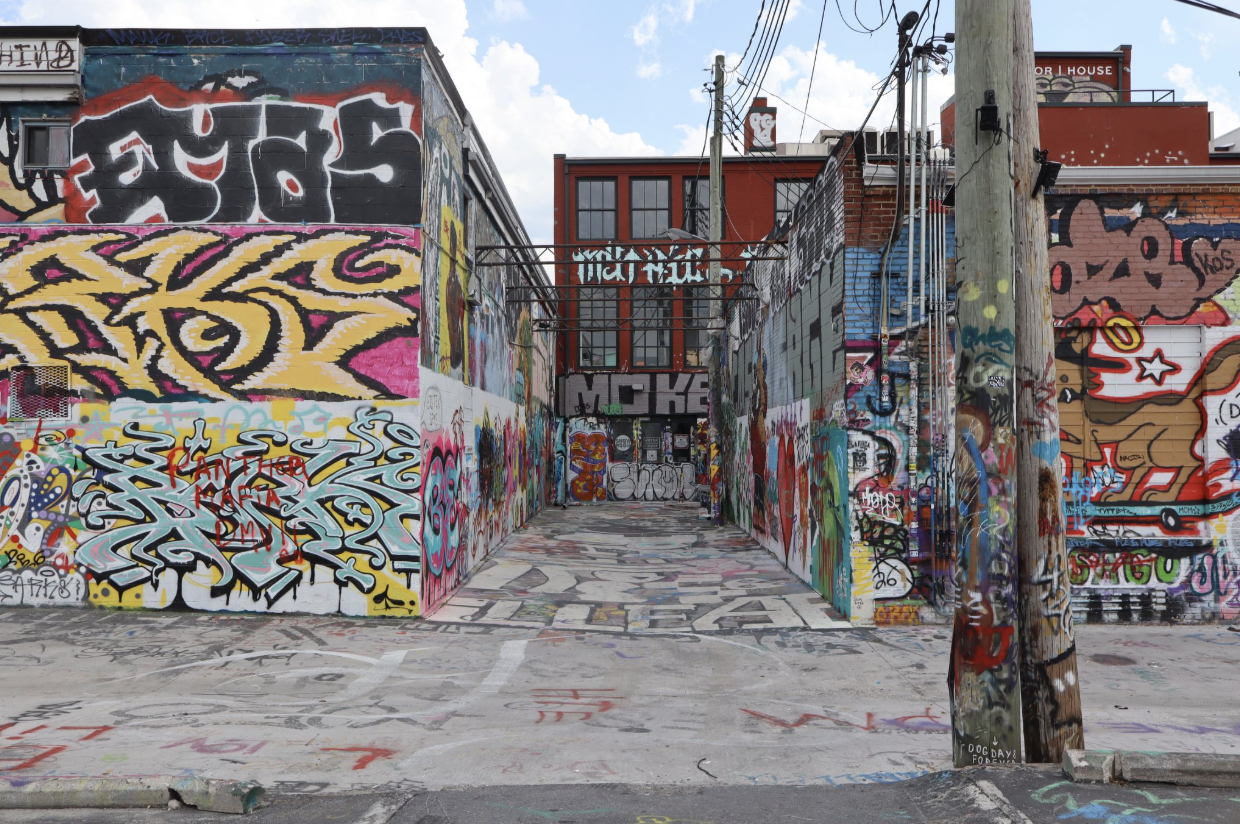
Exterior view of Graffiti Alley taken by Margaret
One of the beauties of this space is its impermanent nature: Because the alley is open to all and there’s no threat of arrest or fines, so many graffiti artists populate the area that artworks are created and covered, then created, rethought, and covered again.
People may visit the alley to practice certain skills, showcase their art, or simply see what art has recently been made.
Between brick and stone buildings, it seems as though the environment has been rebuilt. Every inch of the alley is covered in vibrancy and energy as the murals transform with each new colorful addition. As you walk in, you will see quotes, portraits, tags, references to the city,y and, right now, tributes to BARKS, a famous Baltimore graffiti artist who passed away.
It is expression uncontained. It is the manifestation of the care and community of Baltimore.
There are hundreds of murals and pieces of street art in Baltimore, so here are a few famous ones that you may be familiar with or that may get you started exploring:
"However Far the Stream Flows It Never Forgets Its Source" by Tom Miller, a legacy MICA graduate who expressed Black queer life through a vibrant Afro-Deco style, on the corner of North Avenue and Harford Road.
"Wall of Pride (Back to the Future)," recreated by Ernest Shaw with assistance from GAIA, Mural Masters, Deborah Mason and Michelle Santos, on N. Carey St. in Sandtown-Winchester.
Billie Holiday mural on S. Durham St.
Trayvon Martin mural by GAIA on N. Fremont St.
Portrait mural by ECB (during Open Walls) of the father of Jae Won Kim, owner of Seoul Rice Cake
Malcolm X, Nina Simone and James Baldwin mural by Ernest Shaw in Greenmount West
Baltimore Love Project murals by Michael Owen
"Migración" by Peruvian artist El Decertor at 22nd and Calvert streets
In addition to murals, there are several famous graffiti artists whose tags you will no doubt see in almost every part of Baltimore and even outside the city. RLong, Brown Boy Down for the Revolution (fist holding lightning bolt), Fathers Matter, VENUS, TAVERN and SUKON, to name just a few.
Recently, there have been many murals created across the city, like the B'Kind mural on Howard Street painted by Jay Coleman and sponsored by the CFG Bank Arena.
If you want to check out art in Baltimore, go to the Baltimore Book Festival the weekend of Sept. 12, 2026.