
Students’ opinions about the I.C.E. protests across Baltimore
Maura Wilson | March 19, 2026
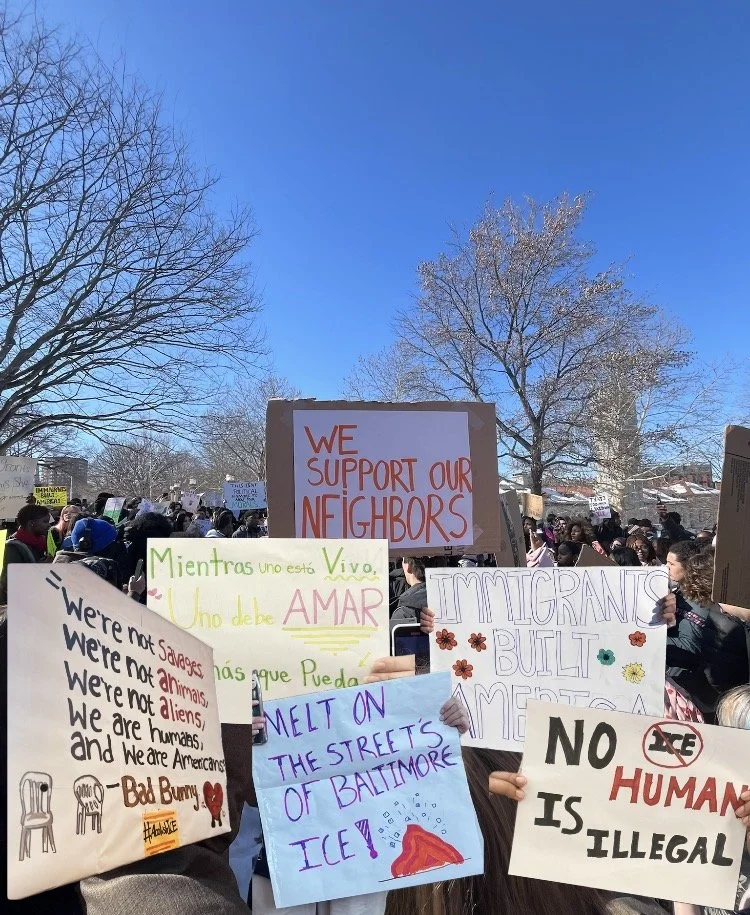
Photo of posters used during a student-led protest | Photo by Amir Muhammad
Students all across Baltimore City organized protests and walkouts at their schools throughout January and into February, opposing actions of the U.S. Immigration and Customs Enforcement.
U.S. Immigration and Customs Enforcement, informally known as I.C.E, have been more prevalent in the United States after the election of Donald Trump. Their goal is to deport and detain undocumented and "illegal" people living in the United States. In more recent months, though, this mission has been blurred and turned more hostile, unjust, and violent. The main target of I.C.E’s actions has been against people who come from or immigrate from Mexico or other Central American countries, which has led to racial profiling. I.C.E has been deporting people and sending them to prisons without trials, one of the constitutional rights, and without proof of said people being "illegal". Many people have many reasons to oppose I.C.E and their beliefs.
I talked to two students who attend Baltimore Polytechnic Institute in Baltimore, Maryland. They described to me what happened, why it happened, and how they felt about the protests.
The first walkout and protest took place on Jan. 23, 2026, with the support of many students and staff.
The first student I interviewed was named Ivy D. She describes the first of the protests held at Poly about I.C.E. “I was in the middle of my last period, kids were walking out, but we didn’t know why yet.” The students walked out onto the Poly fields holding signs and chanting. This quote brings up her greatest flaws and frustrations with the protest. Ivy told me she didn’t know there was going to be a serious walkout, so she wasn’t prepared. This annoyed her because she would have wanted to have a sign and felt that she could have expressed how she felt more if she were prepared. Later, another student told her the cause for the walkout, and when she knew it was for a good purpose, she joined. The way people found out about the protest was through an Instagram post from the night before. Which evidently didn’t spread enough awareness throughout the student body.
“Our teacher wouldn’t let us leave. She said she would mark us as skipping and call our parents. I didn’t really care and left anyway.” Ivy describes one of the many roadblocks to participating in one of these protests – negative teacher intervention, and fear of being punished. Though she herself didn't find that as a setback because she was confident in her morals, but understands it is a factor for other people. After the fact, she talked to her administrator about whether the threats given by her teachers were really being enacted, and their response was no.
Ivy expressed the cause for the walkout and protest. Many students and staff wanted to express their opinion on the events taking place in Minneapolis, Minnesota, which was the main topic of the first walkout/protest. I.C.E agents have taken to the streets in Minneapolis, detaining and kidnapping its residents with little proof that the people aren’t citizens. Many issues can be found with the actions of I.C.E agents and the overall federal government and their presence in Minnesota. Some of those reasons are racial profiling, racism, the lack of justice, and the constitutional process and promise. Students and staff wanted to show their support for the people in Minneapolis who are going through hard times because of resisting I.C.E and standing up for their communities. The protest was a sign of solidarity with them. The students' passion for their cause outweighed their fear of punishment from the school. This resulted in student turnout at the protest and general student support for this first protest.
Overall, Ivy described this walkout very positively and showed her support for the protest and for the cause. Although the lack of promotion of the walkout was more of a setback, with other students having similar experiences as Ivy, along with some negative pushback. She also described some support given to the protesting students. “Most teachers were really supportive, told their kids about it, and let them go”, she told me. Ivy described the first of Poly’s I.C.E.-related walkouts as “super empowering and wonderful”. The examples of setbacks didn’t seem to take away from the meaning and the impact this event had on the students at Poly.
I interviewed another student about another I.C.E protest that took place on Feb. 12, their second protest and walkout. Her name is Delia C., she is a 9th grader, and attended both protests, the one on the 23rd and the 12th. She describes and critiques both of these occasions.
“In my opinion, the I.C.E protests were a good idea in theory. The first I.C.E protest in January was really great, and altogether a good experience,” Delia narrates, “I thought they brought Poly together as a community under one cause.” She corroborates the positive response of the first protest with Ivy’s take. She feels that the first one was empowering and just what students needed to be heard. Delia provided a favorable account of this protest, and she felt its positive impact on the student body.
Delia began talking about the second protest and walkout, which took place first on Poly’s field and then continued throughout the Poly and Western campuses. She described the second protest from a more critical standpoint and gave her feedback. “I enjoyed the second one, but it may have even been too big. Some of the students were treating it like a party and forgetting the reason we were there in the first place. Some students were surrounding other students and telling them to ‘twerk if they hate I.C.E’ on camera, which I personally thought wasn't okay.”
The protest, she described, was less organized and more uncontrolled than the last. Students began doing whatever they wanted without clear guidance or expectations. She felt that the whole point of the protest was to bring awareness to the topic of I.C.E’s actions and to show support for those going through difficult times because of them. While the other students' unprofessional actions gave a reason to overlook the real cause that made the students gather. She felt that those certain actions could be used to discredit the students' voices and give the media a potential reason to call the protest unserious and unpassionate, which it definitely was not.
Delia mentioned that a more positive outcome of the protest was the amount of media coverage. “The protest was getting a lot of coverage from photographers,” she described, “which was good, as I knew our protest was going places and not just an excuse to skip school”. This part of the second Poly protest contrasts with the first one, where the media was less prevalent. Delia showed her appreciation for the second protest because of the impact and coverage it was getting. She also elaborated on the cause for this protest compared to the last. She told me this protest was more generally about opposing I.C.E and how they deport people unjustly, rather than specifically about Minnesota.
Both of the students I interviewed described the protests in a very positive light, even though each protest at Poly may have had their setbacks and faults. Both protests were described as being passionate and inspiring. Ivy and Delia also recount them being quite influential and important, especially to the students, bringing them together and connecting them. Also, it was felt that the students' voices were being heard, appreciated, and valued. It is important to recognize and pay attention to when students feel so passionately about something that they plan and organize others to express their mutual feelings about an issue.